What causes brake pad failure?
The Global Brake Safety Council (GBSC) has conducted in-depth testing to determine the most frequent causes of brake pad failure. They gathered over 10,000 discarded brake pads from shops in Cleveland, OH, Houston, TX and Toronto, Ontario. They chose these locations to represent the effects of snow and road salt on brake pads.
The brake pads were sorted into five categories:
1) No apparent visible cause for replacement
2) Friction material was worn down to the backing plate
3) Brake pad exhibiting excessive rust
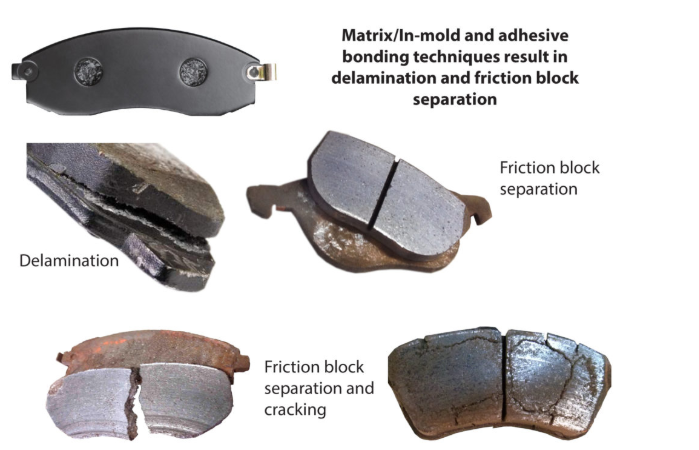
4) Friction material lifted away from backing plate
5) Friction material had broken away from backing plate
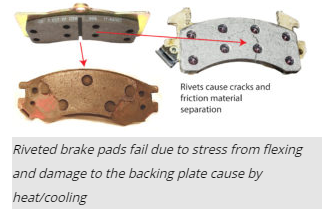
Drilling or stamping holes in the steel backing plate weakens
Riveted brake pads—the oldest and least reliable bonding method
In-mold techniques are also used to bond the friction block to the backing plate. Holes and patterns are stamped into the steel backing plate and the plate is then coated with adhesive. The plate and the raw friction material are placed in a press and squeezed together under tremendous heat and pressure. The pressure forces the friction material through the opening in the backing plate. The friction block is retained with adhesive and the mechanical contact with the backing plate openings.
Matrix and In-mold brake pads